
Before you send the RFQ
Choose 6061 when you need stable machining, weldability, corrosion resistance and straightforward anodising. Choose 7075 only when the strength-to-weight requirement cannot be met otherwise, and accept tighter process control, poorer corrosion behaviour and higher cost. Name the grade and temper on the drawing, and state whether an equivalent grade is acceptable.
What actually differs between the two grades
Both are heat-treatable aluminium alloys, but their alloying systems differ. 6061 is a magnesium-silicon alloy: moderate strength, good machinability, good corrosion resistance, readily anodised and weldable. 7075 is a zinc-magnesium-copper alloy: substantially higher strength, widely used in aerospace structures, but with lower corrosion resistance, a greater tendency to stress-corrosion cracking in some conditions, and no practical weldability. Those differences change fixture design, tool life and the finishing options available to you.
Where strength stops being the deciding factor
A part rarely fails because the alloy is slightly weaker; it fails because of a stress concentration, a thin wall that deflects during machining, or a datum that moves after release from the fixture. Before moving to 7075 for strength, check whether the geometry can be improved: add a fillet, increase a local wall thickness, or soften a sharp internal corner. In many enclosure and bracket applications, 6061 with a corrected geometry outperforms 7075 with the original geometry — at lower cost and with better finishing options.
Machining behaviour and distortion
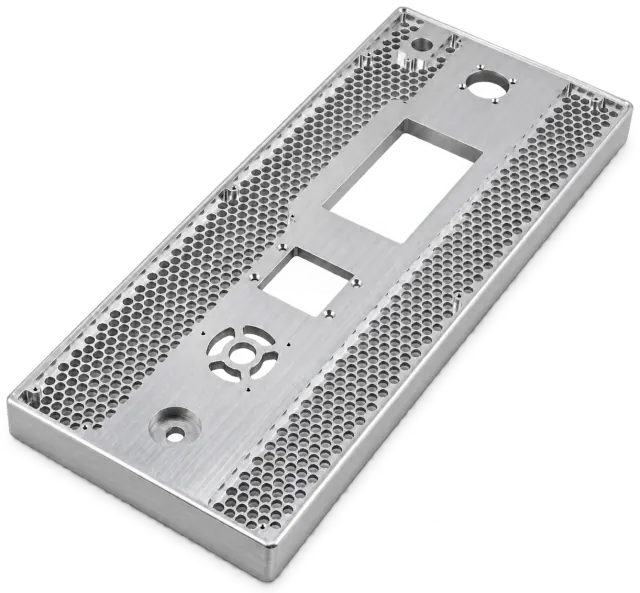
7075 machines cleanly but is less forgiving: it is more sensitive to heat build-up and to residual stress in the plate, so thin sections can move after machining. Our thin-wall enclosure-cover project is a useful reference: 6061-T651 aluminium, 426 × 221 × 36 mm, with a specified flatness of ≤ 0.05 mm, produced through rough machining, stress relief and finish milling with temporary supports. That route was chosen for that geometry and that recorded requirement; a high-strength 7075 plate of similar section would need its own review.
Corrosion, anodising and coating consequences
6061 anodises predictably and accepts conductive conversion coatings and paint systems without unusual preparation. 7075 contains copper and zinc, which affect both corrosion behaviour and the appearance of anodised surfaces; where a cosmetic or protective finish is specified, the grade and the finishing specification have to be reviewed together. If the part will see moisture, salt or cleaning chemicals, this point alone can outweigh a strength advantage on paper.
Cost and supply reality
7075 plate and bar generally cost more than 6061, and availability in the exact thickness and temper is narrower. That affects both the quoted price and the lead time, particularly for thicker sections. If your drawing allows an equivalent grade, say so; if it does not, state why the grade is fixed, because that determines whether we can propose a commercially better route.
What to put on the drawing and the RFQ
Name the alloy and temper explicitly (for example 6061-T651 or 7075-T6), state whether an equivalent grade is acceptable, and identify the surfaces where strength, corrosion resistance or finish matter most. Send the 3D model and matching 2D drawing, quantity, and any finishing or inspection requirement. Our team then reviews geometry, workholding and finishing against the selected grade before quoting, and raises alternatives for your approval rather than changing the specification unilaterally.
| Requirement | 6061 route | 7075 route |
|---|---|---|
| Strength-to-weight | Adequate for most enclosures, covers, brackets and fixtures | Preferred where high strength is the governing requirement |
| Distortion control | Good stability; predictable after stress relief | Higher residual stress; thin sections need extra care |
| Corrosion and finish | Good corrosion resistance; anodises predictably | Lower corrosion resistance; finishing must be reviewed with the grade |
| Weldability | Weldable | Not practically weldable |
| Cost and availability | Lower cost, wide stock availability | Higher cost, narrower availability in some tempers |
Frequently asked questions
Can I substitute 6061 for 7075 without changing anything else?
Only if your drawing allows an equivalent grade and the strength requirement still passes. A substitution changes strength, corrosion behaviour and finishing; we raise it as a drawing question rather than making the change ourselves.
Which grade is better for anodising?
6061 anodises more predictably. 7075 contains copper and zinc, so the anodised appearance and corrosion behaviour need the finishing specification reviewed together with the grade.
Is 7075 harder to machine?
It machines cleanly but is less forgiving of heat build-up and residual stress, which matters on thin sections. The route, fixturing and stress relief are planned around the geometry rather than the grade name alone.
Do you machine both 6000 and 7000 series aluminium?
Aluminium alloys are within our material scope and each route is planned per drawing. State the grade, temper and any equivalent-grade allowance in the RFQ so the process and the quotation reflect the actual material.
How does grade choice affect price and lead time?
7075 stock is usually more expensive and less widely available in some thicknesses and tempers, which affects both price and delivery. Saying whether an equivalent grade is acceptable lets us quote the most practical route.
NEXUS provides drawing-based machining and engineering review. Values in project examples are specific requirements, not general capability limits. The review scope and any proposed changes are agreed with your team.
Discuss your project